
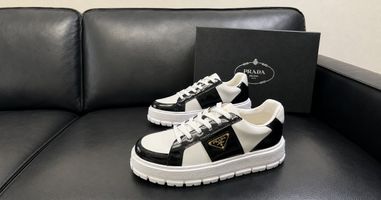
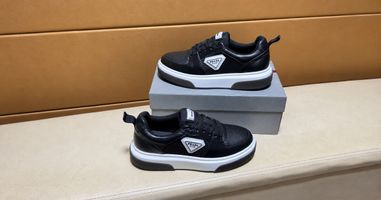
1. A Size Number Is Only a Reference
A familiar number can still feel wrong by the end of an hour.Length explains only part of fit.Forefoot shape,instep height,and the way the heel settles into the rear can change the result completely.A lace-up controls volume through its closure;the same adjustment is unavailable in a loafer.Meanwhile,padding can make a roomy sneaker feel secure during a brief try-on.
Judge the actual contact rather than the label.The toes should remain relaxed,the forefoot should not be forced inward,and the heel should travel with the shoe.A printed size narrows the search.That is all it can do.
2. Quick Answers Before Choosing a SizeDo Different Styles Fit the Same Way?
No single answer applies to every shape.prada men shoes can differ in toe form,lining,upper structure,and closure.Use your usual size for the first trial,then judge the shoe itself.
How Much Toe Room Should Remain?
The longest toe should stay clear of the front while standing and walking.Room for natural movement is useful;enough empty length to let the foot slide forward is not.A tapered or rounded toe may also look longer than the usable interior.
Is Slight Heel Movement Normal in Loafers?
A small amount of movement may occur in a new loafer,especially before the sole begins to flex more naturally.The heel should not lift dramatically,rub hard,or force the toes to grip the shoe to keep it on.
Should Wide Feet Automatically Size Up?
Not automatically.A larger size adds length along with width.When length is already correct,going up may loosen the heel without relieving the original pressure.Last shape matters more than a universal rule.
Can Break-In Correct a Tight Fit?
Some leather uppers soften and give slightly across flex areas.They do not gain meaningful length.Break-in should refine a close but comfortable fit,not rescue compressed toes,sharp pressure,or an unstable heel.
3. Use a Shoe You Already Wear as a Baseline
“I usually wear this size” is a weak baseline.Choose a pair that remains comfortable after several hours and inspect what it gets right.Where does the widest part of the foot meet the shoe?How much space remains ahead of the longest toe?Does the heel stay centered through a turn?
Construction matters here.A running-style sneaker offers a poor comparison for a leather loafer because padding,lacing,and sole flexibility alter the experience.Match sneaker with sneaker,loafer with loafer,and boot with boot when possible.A removable insole can provide another reference;otherwise,compare the outsole and interior shape by hand.None of these checks is exact,but obvious differences in length,width,or instep volume become easier to see.
4. Measure for the Way the Shoe Will Be Worn
Feet are rarely identical,and they expand through an active day.Measure both while standing,then begin with the larger foot.A small difference between sides is ordinary;the pair still needs to accommodate one without leaving the other unstable.
Use the socks that belong with the shoe.A thin dress sock changes the fit of a loafer or lace-up very little.A cushioned athletic sock occupies more volume inside a sneaker.A boot intended for colder days needs to be tested with the weight of sock it will actually meet.
Record heel-to-toe length and forefoot width before translating either measurement into a size label.Rounding too early hides useful differences between the feet.If a tracing is used,keep the pencil upright and avoid letting it angle beneath the foot.Then compare the result with the interior shape of the shoe rather than treating a conversion chart as a promise.A chart can identify a sensible first pair to try;it cannot account for toe shape,lining thickness,or instep volume.
Take measurements later in the day,after the feet have been active.Prada shoe sizing for men should reflect the demanding hours,not only the first minutes after getting dressed.A pair that feels exact in the morning may become restrictive after commuting,walking,and standing.
5. Read Four Fit Areas Separately
At the front,the toes should lie naturally instead of curling or pressing together.The longest toe needs clear space,yet the foot should not travel forward whenever the body changes direction.The widest part of the forefoot should also meet the widest part of the shoe.Close contact can feel reassuring.Concentrated pressure that builds quickly usually signals a shape conflict.
Instep and heel often explain a fit that otherwise seems puzzling.A high instep may meet firm pressure beneath a loafer vamp or closed lacing area.A low one can leave enough unused volume for the heel to move despite correct length.The rear should stay centered without digging into the tendon.Walk,turn,and rise onto the forefoot;standing still reveals only part of the fit.
6. Toe Room Is Not Extra Length
Long-looking shoes do not always provide more usable space.Some silhouettes extend beyond the toes as part of their design,while others place the front wall closer to the foot.Feel where the toes actually end instead of judging from the outside profile.
If the toes have room but the foot keeps sliding forward,the problem may be excess volume at the instep or heel rather than insufficient length.If the big toe or second toe reaches the front while the heel remains secure,the size may simply be too short.If the smaller toes are pushed inward,forefoot shape deserves attention before length.
This is why prada shoes for men in different silhouettes cannot be judged from the label alone.An open loafer,a slim lace-up,and a padded sneaker can share a size while giving the foot very different working space.
7. Width and Instep Decide More Than Many Buyers Expect
Width problems are easy to misread.A shoe may feel tight because the forefoot is genuinely too broad for the interior.It may also feel tight because the foot sits too far forward,or because the upper presses down over a high instep.Each problem calls for a different response.
Check the skin and socks after several indoor steps.Deep pressure lines,localized heat,or tingling are more useful evidence than the vague idea that a new shoe should feel firm.A secure fit distributes contact.A poor match concentrates it.
Instep volume becomes especially important in slip-on designs.Too much pressure across the top of the foot can make a loafer tiring even when the toes feel free.Too little contact allows the foot to rise and slide.A thin insert or tongue pad may refine a small volume difference,but an accessory should not be expected to rebuild the basic shape of the shoe.
8. Sneakers Need Movement Without Interior Drift
Laces,padding,and flexible materials make sneakers seem forgiving.They can also hide a poor match during the first minutes.A heel held by overtightened laces may lift once the wearer reaches a normal pace,and a forefoot that feels close while seated can become crowded after sustained activity.Tie the shoe as you would outside,then walk quickly,stop,and change direction.The midfoot should stay held without pressure gathering beneath one narrow band.
The bend of the sole offers another clue.It should sit near the natural flex of the forefoot.When it falls too far ahead or behind,the labeled size may look reasonable while the geometry remains wrong.Thicker soles reduce ground feedback,which makes heel stability and interior movement worth checking deliberately.
9. Loafers Require a Different Standard
A loafer depends on the relationship between heel,instep,and vamp.There are no laces to compensate for unused volume,and choosing a very tight pair in the hope that it will become perfect later creates unnecessary risk.
Stand first,then take several normal steps.A small initial heel lift can settle as the sole begins to flex,but the shoe should return with the foot rather than lag behind it.The toes should remain relaxed.If they grip the footbed to keep the shoe on,the interior is probably too loose or the instep hold is poorly matched.
Watch the heel again once the forefoot begins to bend.A stiff new sole can pull the rear down slightly during the first steps,which feels different from a heel that floats inside an oversized upper.The first usually becomes less pronounced as the sole flexes by hand and underfoot.The second remains visible even when the shoe is moving freely.A thin sock will not correct that gap.
Sock choice can change the result more than expected.A loafer tested barefoot may behave differently with a thin sock,and a thicker sock can make a close vamp restrictive.Decide how the shoe will normally be worn before deciding which sensation is correct.
10. Lace-Ups,Boots,and Sandals Need Their Own Checks
Lace-ups provide the greatest ability to adjust volume,but the closure should not do all the work.The facings need enough room to tighten and relax without spreading under strain or closing completely while the heel still moves.Pressure beneath the laces should be broad and even rather than concentrated over one eyelet.
Boots add sock thickness,ankle movement,and shaft shape to the decision.Walk up a step if possible and bend the ankle forward.The heel may move slightly in some constructions,but it should not strike the rear repeatedly.The shaft should allow movement without cutting into the ankle or forcing the foot forward.
Sandals shift attention to the footbed and straps.The heel and longest toe should remain within the edges during a full step.Straps need enough hold to prevent sideways drift without leaving sharp marks.Each part of prada footwear asks for a different test because security comes from different areas of the construction.
11. Break-In Cannot Repair Every Mismatch
Break-in changes flexibility more reliably than dimensions.A leather sole begins to bend with less resistance,a structured upper may soften at its natural crease,and the lining can settle around the heel.Those changes personalize a sound fit.
Length does not meaningfully increase.The widest area stays where it is,and a misplaced arch will not reorganize itself through wear.Persistent toe contact,numbness,sharp side pressure,or severe heel movement is evidence of mismatch.Stiffness usually spreads across a broader area and eases as the shoe flexes.Misalignment returns to the same place with every step.
12. When Two Sizes Both Seem Possible
When the smaller option feels secure but touches the toes,and the larger option clears the front but moves at the heel,neither may be ideal.The issue may be the shape rather than the size.Do not choose based only on which problem appears easier to tolerate.
Test both indoors on a clean surface.Wear each for several minutes rather than switching after a few steps.Stand naturally,walk at normal speed,turn in both directions,and rise onto the forefoot.Check again after the upper and lining have warmed slightly.
Use the same socks and lacing tension for both pairs.A comparison is useful only when the conditions match.If an insert is part of the normal plan,test it from the beginning rather than imagining its effect.If the retailer permits returns,keep every trial indoors and preserve the condition of the soles.
Useful notes on how Prada men shoes fit name the exact style and the wearer’s foot shape.“Size up” or “size down” leaves out the reason.A broad forefoot with a low instep can produce a different decision from a narrow foot with a high instep.
13. Match Fit to the Longest Part of the Day
A shoe worn mainly to dinner meets a different demand from one expected to handle airports,commutes,and long city walks.Discomfort is never the goal,but the final check should reflect the hardest part of the real schedule.
Before keeping the pair,ask whether the toes stay relaxed,whether the forefoot can widen naturally,whether the instep is held without pressure,and whether the heel remains controlled after repeated steps.Then consider socks,walking time,standing time,and the clothing that determines how the shoe will be used.
Once fit is settled,the next question is where the pair belongs.Our guide to prada men casual shoes for work,travel,and weekends follows that decision through real schedules.The best size remains stable when the day becomes more active;it does more than feel acceptable while standing still.