
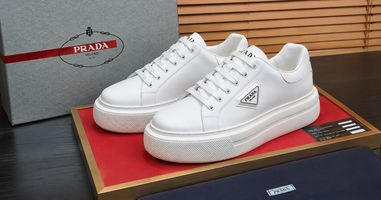
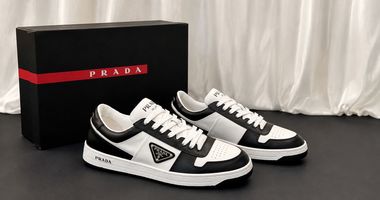
Choosing a sneaker by material name alone can lead to the wrong conclusion.The more useful question is where each material sits and what it does there.Leather around the heel can add support,while the same material crossing the forefoot bend may increase resistance.Mesh can improve airflow,but only when it remains exposed instead of being buried beneath several overlays.
Among prada men sneakers,the strongest designs do not use the greatest number of materials.They place each one where it improves support,movement,protection,or visual balance.A layer with no defined purpose may add more complexity than value.
1.Read the Upper as Five Separate Zones
A sneaker upper should not be judged as one continuous unit.Divide it into five zones toe,the forefoot bend,the sidewall,the heel,and the tongue-and-collar area.
The toe needs enough firmness to preserve shape.The forefoot must bend repeatedly.The sidewall influences support and apparent width.The heel controls rear stability.The tongue and collar affect entry,pressure,and how enclosed the foot feels.
Two shoes described as leather-and-nylon can therefore behave differently.One may use leather only as a rear frame and leave the forefoot flexible.Another may place thick overlays across every moving section.The material list is similar,but the result is not.
2.The Forefoot Is Where Placement Becomes Physical
Several materials often meet around the forefoot bend.A soft,continuous panel can move with little interruption.A firm overlay crossing that point creates another layer that must flex with every step.Multiple seams in the same area may add resistance even when none of the materials is especially rigid.
Not every overlay is unnecessary.A strip may hold the upper together,protect an edge,or prevent a soft panel from spreading too far.The question is whether its position supports movement or merely adds detail.
With prada men shoes,read a complex forefoot line by line.Find the likely crease,then check how many panels,stitches,and changes in thickness pass through it.A layered shoe may still move easily when the main flex zone remains open.A simpler-looking upper can feel firmer when one dense panel covers the entire bend.
The useful distinction is not leather versus nylon.It is whether the flex remains controlled or becomes interrupted.
3.A Stable Heel Does Not Require a Heavy Entire Shoe
Rear support can be concentrated.Leather,internal reinforcement,or a rubber frame around the heel can hold the back of the shoe without making the entire upper dense.
This explains why some mixed-material sneakers feel more controlled than their lightweight appearance suggests.The forefoot can remain soft while the heel preserves its form.
The opposite can also happen.A shoe may look substantial because of layered side panels while the heel remains easy to collapse.Visual mass and rear stability are not the same thing.
4.The Sidewall Changes the Apparent Width
The direction of the materials along the side changes how the whole shoe is read.A long horizontal panel can visually lengthen the foot.A vertical frame adds height.Crossing lines create interruption and make the upper appear denser.
Color strengthens the effect.A dark sidewall above a light midsole creates a clear horizontal division.A tonal upper and sole reduce that break.Rubber rising from the base onto the side can make the shoe look wider even when the interior shape remains unchanged.
The side view therefore deserves more attention than the logo.It reveals whether the materials lengthen,divide,or visually enlarge the shoe.
5.Mesh Can Be Present Without Delivering Much Airflow
Mesh is often treated as proof that a sneaker will feel cooler,but visible mesh does not guarantee effective ventilation.A small window covered by leather strips may change appearance more than temperature.A breathable outer section can also sit above a dense lining that restricts air movement.
Placement and scale matter.Mesh across an exposed toe or sidewall has more opportunity to move air than fabric trapped beneath several overlays.A thick tongue and heavily padded collar may keep the shoe enclosed even when the forefoot includes open material.
When comparing prada men shoes,check the exposed mesh area,the lining beneath it,and the structure surrounding it.A few fabric sections may soften the appearance without materially improving warm-weather performance.
6.Every Extra Layer Creates a Complexity Cost
Each additional layer can introduce a seam,a change in stiffness,a new crease line,or another color block.None of these is automatically negative,but every layer should earn its place.
A rubber piece near a high-contact zone has an understandable role.A leather frame around soft nylon can help preserve shape.A reinforced eyelet panel can distribute lace tension.An additional overlay crossing an area that is already supported may contribute little beyond visual density.
This creates a complexity cost.The buyer gains more texture and depth,but also more interruption and more points where the upper changes behavior.The tradeoff is worthwhile when the design improves support,protection,or flexibility.It becomes harder to justify when the extra layers only make the shoe busier.
Mixed materials work best when their roles are easy to understand holds,nylon softens,rubber protects,and mesh opens the upper.
7.When Re-Nylon Changes the Shoe—and When It Does Not
Re-Nylon changes a sneaker most clearly when it forms a large part of the body beneath a smaller structural frame.In that position,it can reduce surface rigidity,soften the sidewall,and give the upper a drier,more technical appearance.
It makes less difference when only a small section remains visible,when thick overlays cover most of it,or when a heavy sole controls the entire experience.A nylon panel cannot make the shoe feel light when the lower construction remains large and resistant.
When comparing prada sneakers for men,look at how much of the upper Re-Nylon actually controls and whether the surrounding elements allow its lighter character to remain visible.Material prestige does not determine refinement.Surface continuity often matters more.
8.Compare Construction Patterns,Not Material Lists
Three construction patterns make comparison easier.
Single-Surface Construction
One dominant material covers most of the upper with few interruptions.This creates a calmer line and makes creasing easier to anticipate.The weakness is that one surface must handle most of the shoe's demands.
Framed Construction
A softer body is supported by firmer sections around the heel,eyelets,toe edge,or sidewall.This can separate flexibility from support effectively when the frame follows the shoe's movement.
Layered Construction
Several overlays create depth,protection,and a stronger identity.It also carries the highest complexity cost because every layer can alter movement and proportion.
These patterns explain more than a simple leather-versus-nylon comparison.A leather upper may still be heavily layered,while a nylon design can remain visually calm when its surface is continuous.
9.Use the Bend,Press,and Side-View Test
A quick three-part check can reveal more than a material label.
• Bend:Observe where the upper folds and how many panels cross that point.
• Press:Compare the heel,sidewall,and forefoot to see where support is concentrated.
•Side View:Check whether the direction of the materials makes the shoe appear longer,wider,or more divided.
This test does not replace size or comfort assessment.It shows whether the upper has been organized around movement and support rather than surface detail alone.
10.One Material Should Not Perform Three Conflicting Jobs
Problems appear when one panel is expected to provide structure,flexibility,and decoration at the same time.A thick leather piece may hold the sidewall effectively but become less convincing when it also crosses the main bend and carries a high-contrast graphic.A soft textile may move easily yet fail to preserve shape when no frame supports it.
Strong design separates those tasks.A firmer material holds the heel or lace area.A flexible section handles repeated bending.A protective piece sits where contact is likely.Visual details follow those divisions instead of competing with them.
This division of labor does not require a complicated upper.Changes in thickness,internal reinforcement,and carefully placed stitching can achieve the same result with fewer visible layers.
11.The Best Construction Gives Every Material a Reason
The best prada men sneakers are not automatically the simplest or the most layered.They are the designs in which each material has a specific assignment and does not interfere with another zone's work.
Leather can support the heel.Mesh can open an exposed section.Nylon can reduce rigidity across a larger panel.Rubber can protect areas likely to meet repeated contact.When a material improves support,movement,protection,or proportion,its presence makes sense.When it changes none of them,it may be adding complexity without improving the shoe.
Read the upper by zone,then by construction pattern.A well-organized material hierarchy usually produces a sneaker that is easier to understand,compare,and appreciate beyond the product image.