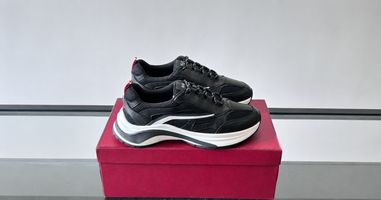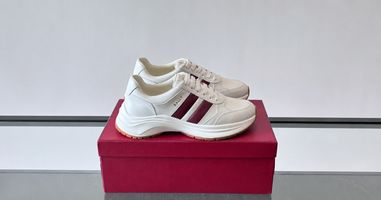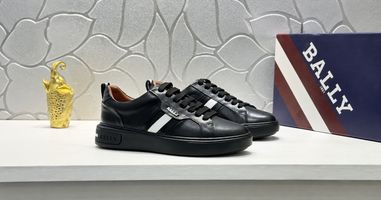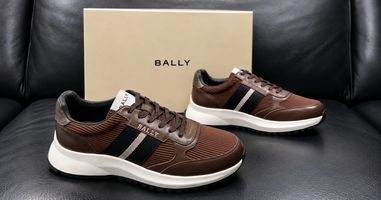
1.The Quick Fit Answer
The correct size cannot be judged by length alone.A slim leather sneaker may leave enough space in front of the toes while still pressing across the forefoot.A broader-looking design may appear generous from the outside,but thick lining and layered panels can reduce the usable room inside.
This is why bally men sneakers do not follow one reliable rule such as “always true to size” or “always size down.”The same numerical size can feel different when the toe shape,sole width,heel construction,and internal padding change.
Stay with the usual size when the heel remains secure,the forefoot sits fully over the sole,and the shoe bends near the natural flex point.Consider half a size up only when the shoe is genuinely short.When extra length creates heel movement without relieving pressure,the better solution is usually another model rather than another size.
2.Why a Size Number Tells Only Part of the Story
A size number mainly organizes length.It does not describe every dimension inside the shoe.
Two sneakers marked with the same size may use different lasts.One may taper earlier around the toes.Another may have more space across the ball of the foot but hold the heel more tightly.A third may use thick foam around the collar,leaving less internal room than its exterior suggests.
The difference often becomes clearer after walking.A shoe that feels acceptable while sitting may allow the foot to slide forward on stairs,while a flexible upper can still rest over a platform that is too narrow.
Size answers whether the foot can enter the shoe.The last determines whether the foot stays in a stable position once movement begins.
3.The Four Fit Zones That Matter
Instead of asking only whether a sneaker feels large or small,divide the fit into four zones.
• Toe length toes should not repeatedly meet the front during normal walking.
• Forefoot width ball of the foot should sit over the supportive part of the sole rather than pushing beyond its edges.
• Instep volume upper and lacing area should hold the foot without creating a concentrated band of pressure.
• Heel shape rear of the shoe should follow the heel closely enough to limit lifting.
A problem in one zone does not automatically mean the whole shoe is the wrong size.For example,a secure heel and correct length combined with forefoot pressure usually suggest a shape issue,not a general sizing error.
4.Length,Width,and Internal Volume
Length runs from the heel to the front of the shoe.Width describes the horizontal space across the forefoot.Internal volume describes the three-dimensional room around the foot,especially above the instep.
These dimensions can move independently.A sneaker can be long and low-volume,short and broad,or wide through the sole but heavily padded inside.
When comparing different bally men sneakers,notice where the pressure appears.Pressure at the toe tips suggests insufficient length.Pressure along the outer forefoot points toward width.A tight feeling beneath the laces usually relates more closely to instep volume.
This distinction prevents an unnecessary size increase.A man with enough toe room but excessive instep pressure may gain unwanted length by moving up half a size,while the original structural mismatch remains.
5.How Slim Leather Sneakers Behave
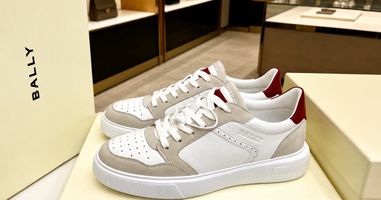
Low-profile leather sneakers often create a polished line because the sole and upper remain visually controlled.That same shape can make the internal fit feel more precise.
The toe area may begin tapering earlier,and the sidewalls may sit closer to the foot.A smooth leather upper can gradually soften around pressure areas,but the platform beneath it does not become wider.
This matters for men whose forefeet spread noticeably when standing.A slim sneaker may feel acceptable in the usual size for several minutes,then create pressure along the little toe or ball of the foot after extended wear.
Moving up half a size can help when the shoe is also short.It is less effective when the main issue is width.A longer slim shoe may simply leave more empty space in front while continuing to press from the sides.
6.Why Chunky Does Not Always Mean Roomy
A substantial exterior can be misleading.
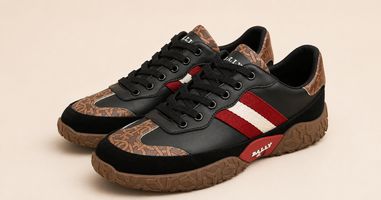
Chunky and layered sneakers may have a broad outsole,but part of that width can sit outside the usable foot chamber.Thick lining,padded tongues,reinforced side panels,and structured collars all occupy internal space.
This creates an important distinction between external volume and internal volume.The shoe may look large beside a low-profile design while feeling equally close around the instep.
Heavier construction also changes heel behavior.When the rear of the shoe does not hold securely,the weight of the sneaker can increase movement as the foot lifts.Adding size may make that problem more noticeable.
A broad outsole can still improve stability,but only when the foot rests in the correct position above it.
7.The Role of Padding and Layered Uppers
Padding can make the first contact feel comfortable.It can also hide the real fit for several minutes.
A thick tongue may compress after wear,but it can initially reduce space over a high instep.Padded collars may improve heel contact,although excessive softness can allow movement once the material settles.Layered side panels can create local pressure that does not appear in a simpler leather upper.
The useful question is not whether the sneaker feels cushioned.It is whether the pressure remains evenly distributed after the foot warms and the materials begin to respond.
Initial softness describes surface contact.Later pressure reveals whether the internal shape actually works.
8.Compare Models Before Changing Size
When one design feels restrictive,it is tempting to assume that every sneaker from the brand requires the same adjustment.That can create a new problem in a model with a different internal shape.
A slim leather pair may feel close across the forefoot,while a sport-influenced design in the same size may provide more lateral room.A layered sneaker may look broader but feel lower over the instep.A lighter design may use less padding and therefore feel more spacious without being longer.
Comparing several bally sneakers for men may show that the pressure comes from the model’s internal shape rather than the size itself.
This is especially useful when the usual size feels secure at the heel but uncomfortable elsewhere.That combination often indicates that the rear fit is correct while the front or upper shape is not.
9.Wide Forefeet and Narrow Heels
One of the most difficult combinations is a broad forefoot with a relatively narrow heel.
Sizing up may reduce pressure at the front,but it can also create lifting at the back.Tightening the laces may reduce some movement,yet it can add pressure over the instep without changing the heel shape.
A better option is usually a model with more usable forefoot width and a defined rear structure.The goal is not maximum overall space.It is space in the correct location.
The foot should not hang over the edge of the supportive platform,even if the leather upper feels soft enough to accommodate it.
10.High Instep Fit
A high instep often creates pressure beneath the tongue or across the lower section of the laces.The toes may still have enough room,and the heel may remain stable.
Loosening the laces can reduce pressure,but only to a point.If the upper begins pulling widely apart or the foot no longer feels contained,the sneaker likely lacks sufficient internal volume.
Moving up half a size may add some volume,but it also changes length and heel position.This is why a roomier construction in the original size can fit better than a longer version of the same narrow model.
Watch for numbness,deep lace marks,or pressure that increases instead of settling.These are stronger signals than a general feeling of firmness during the first minute.
11.When Staying True to Size Makes Sense
The usual size is probably correct when the foot remains stable and no single area carries excessive pressure.
The toes should move naturally without the foot sliding forward.The forefoot should feel contained rather than compressed.The heel may move very slightly as the shoe bends,but it should not lift repeatedly.
The flex point should also align with the ball of the foot.If the sneaker bends noticeably ahead of or behind that area,the numerical size may be close while the last is still unsuitable.
Across bally men sneakers,a controlled fit is usually more useful than extra empty space,provided the toes and forefoot can still move naturally.
12.When Half a Size Up Can Help
Half a size up is most useful when the shoe is genuinely short.
Clear signs include:
• The toes repeatedly contact the front.
• The longest toe cannot rest naturally while standing.
• Downhill walking or stairs push the toes firmly forward.
• Thicker socks make the current length insufficient.
• One foot is clearly longer and cannot be accommodated comfortably.
Even then,the heel should remain secure in the larger size.If the shoe becomes loose at the back or bends in the wrong place,the additional length has created a new mismatch.
Sizing up changes length and sometimes volume.It does not redesign the last.
13.When a Different Model Is the Better Answer
Changing the model is usually more effective when the original size feels tight but the next size feels unstable.
Other warning signs include:
• The foot extends beyond the supportive width of the sole.
• Pressure remains concentrated beneath the laces.
• The heel lifts after the size is increased.
• The shoe bends away from the natural forefoot position.
• The toe shape forces the toes inward despite sufficient length.
A correctly sized sneaker can also be wrong for the intended routine.A slim leather pair may fit well for office use but feel too firm for a walking-heavy trip.Fit should therefore be considered alongside choosing the right bally sneaker for daily use,not treated as a separate numerical decision.
The best model is the one that fits the foot and the task at the same time.
14.A More Useful Try-On Check
A long testing routine is unnecessary,but the sneaker should be evaluated while standing and moving.
First,stand with weight distributed normally.The foot spreads more under body weight than it does while sitting.Then walk at a natural pace,turn,and use a few steps if available.Pay attention to whether the heel lifts,where the shoe bends,and whether the foot slides forward.
Keep the pair on long enough for early pressure patterns to appear.A soft upper can make the first minute misleading.If one area becomes increasingly noticeable,the structure is unlikely to improve simply because the shoe looks correct.
A comfortable fit should become less noticeable during movement,not more.
15.The Final Size Decision
Keep the usual size when length,forefoot width,instep space,and heel hold work together.
Consider half a size up when the sneaker is clearly short and the larger size still controls the heel.
Choose another model when:
• The original size compresses the forefoot.
• The larger size creates heel movement.
• The instep remains pressured despite correct length.
• The outsole does not support the full width of the foot.
• The flex point does not match the foot.
Do not expect leather softness to correct a structural mismatch.The upper may soften,but sole width,heel shape,and flex position remain largely unchanged.When those three areas are wrong,changing the model is more reliable than waiting for the sneaker to break in.
Common QuestionsDo Bally Men Sneakers Run Big or Small?
There is no reliable answer that applies to every design.Slim leather,layered,and sport-influenced sneakers may differ in toe shape,padding,internal volume,and heel construction,even when they carry the same stated size.
Should Wide Feet Size Up?
Not automatically.Sizing up may add length without providing meaningful width.If the larger size causes heel lifting,a model with more usable forefoot space is the better choice.
Can Leather Sneakers Stretch?
Leather can soften and adapt around the foot.It cannot make the outsole wider or change the underlying last enough to solve a major structural mismatch.
Why Does a Chunky Sneaker Feel Tight?
A broad exterior does not guarantee broad internal space.Thick lining,padded tongues,and layered side panels can reduce the room available to the foot.
Why Does the Heel Slip When the Length Feels Correct?
The rear shape may not match the heel,or the sneaker may have more internal volume than the foot needs.Heel movement does not always mean that the entire shoe is too large.