
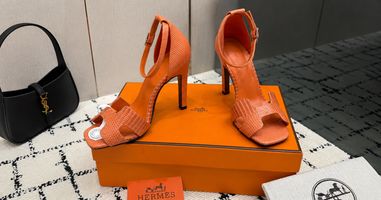
Hermès Women Shoes Fit Toes,Heel Slip,and Sandal Placement Explained
Hermès women shoes should be judged by where the foot sits inside each construction,not by visible toe length alone.Pointed shoes need usable forefoot width,ballet flats need heel security without toe gripping,sandals need the foot centered within the sole,and pumps need enough front space to avoid repeated pressure as the foot moves forward.
When one area feels wrong,check whether changing size improves the entire foot or simply shifts the problem elsewhere.
1.Four Women's Fit Problems Need Different Answers
Different constructions can fail in different places.
A pointed flat can have visible space at the tip while pressing across the forefoot.A ballet flat can feel correct through the front but lift at the heel.A pump can have enough overall length while allowing the foot to move forward.A sandal can sit beneath the upper while placing the toes or heel too close to the sole edge.
These problems should not all lead to the same response:
Size up.
or
Size down.
First identify where the fit stops working.Then ask whether the cause is overall size,internal shape,heel volume,forefoot width,or the way the shoe holds the foot.
2.Pointed Toe Length Can Be Misleading
A pointed shoe often extends beyond the actual toes.
That extra visual length does not mean the entire front is usable space.The toe box may begin narrowing well before the visible tip ends.
This can create a confusing combination:
•Empty space at the front
•Pressure around the little toe
•The big-toe joint pressing against the sidewall
•A compressed forefoot despite adequate overall length
Pressing the end of the shoe and finding empty space does not answer the fit question.
A better check is whether the widest part of the foot sits comfortably before the toe box begins to taper.
3.Check Where the Toe Box Begins to Narrow
The critical area of a pointed shoe is not the tip.
It is the transition where the front begins moving inward.
Among hermès women shoes,pointed flats,slingbacks,and pumps should be evaluated by usable forefoot area rather than external toe length.
Check:
•Whether the ball of the foot sits before the narrowing becomes aggressive
•Whether the little toe is pushed inward
•Whether the big-toe joint meets the sidewall too early
•Whether the toes stay reasonably flat
•Whether walking pushes the forefoot farther into the tapered section
A pointed shoe can have considerable visible length and still provide too little usable width.
The functional front of the shoe ends before the visible point does.
4.Ballet Flats Should Not Stay On Because Your Toes Grip Them
Ballet flats can expose a fit problem that is easy to miss.
If the heel lifts,the wearer may begin curling the toes to keep the shoe attached during each step.That compensation can make the shoe seem more stable than it really is.
Watch for:
•Heel lift increasing during walking
•Toes gripping the insole
•The foot moving forward before the heel rises
•Sizing down improving rear security but compressing the forefoot
A low-cut upper does not mean the shoe should feel locked around the ankle.But it should stay on without requiring the toes to perform the job of a strap or lace.
If securing the heel requires a smaller size that crowds the front,the problem may not be length alone.
5.Heel Slip Can Come From More Than Extra Length
Heel slip is often interpreted as proof that a shoe is too large.
That is only one possibility.
The cause may also involve:
•A heel opening that does not match the rear foot
•Too much internal volume around the midfoot
•A forefoot that prevents the foot from sitting farther back
•A low-cut design with less material around the heel
If the heel lifts while the forefoot already feels secure,automatically sizing down can create unnecessary front pressure.
If the heel becomes stable only after the toes start gripping,the fit has not genuinely improved.
Rear security should improve without forcing another part of the foot to compensate.
6.A Pump Can Fit in Length and Still Push the Foot Forward
A pump can have enough visible length and still place the foot poorly once movement begins.
With hermès women heels,the key question is whether the foot stays where the shoe was designed to hold it.
Forward movement can create two problems at once:
•Increasing forefoot pressure
•A growing gap around the heel
Check whether:
•The ball of the foot shifts forward after several steps
•Toe pressure increases during walking
•The heel becomes less stable as the foot moves
•Sizing down reduces movement but creates greater compression
A shorter size is not necessarily the answer if the real problem is forward migration inside the shoe.
7.Slingbacks Need Strap Security Without Forcing the Foot Forward
A slingback adds another variable tension.
The strap needs enough security to stay in place,but it should not pull the rear of the foot so firmly that the forefoot is pushed deeper into the shoe.
Check:
•Whether the strap stays in position
•Whether it slips downward during walking
•Whether tightening changes pressure at the front
•Whether the heel remains aligned
•Whether the shoe stays stable through turns
A loose strap may fail to control the heel.A strap that is too tight can solve that issue by creating another farther forward.
The correct adjustment should stabilize the shoe without relocating the foot.
8.Sandals Need the Whole Foot Inside the Platform
Open sandals should be judged by placement on the sole rather than closed-shoe toe-room rules.
Look from above and from the side.
Check:
•Whether the toes stay inside the front edge
•Whether the heel stays within the rear boundary
•Whether the widest part of the forefoot sits inside the side edges
•Whether the upper keeps the foot centered
•Whether walking causes the foot to shift forward or sideways
A sandal can fit beneath the straps yet still place the foot poorly on the platform.
The more useful question is:
Does the foot stay inside the area the sole was designed to support?
9.One Size Change Can Fix the Wrong Problem
A size change should improve the whole fit,not merely the most noticeable pressure point.
A ballet flat may stop slipping after sizing down,but if the forefoot becomes compressed,the smaller size has not solved the fit.
A pointed flat may gain width after sizing up,but if the heel starts lifting with every step,the larger size has introduced another problem.
A sandal may feel less tight across the upper after sizing up while placing the foot too close to the sole edges.
When comparing hermès women shoes,look for a size and construction that improve heel security,forefoot space,and overall foot placement together.
A correction only works when the rest of the foot improves with it.
10.Walking Reveals What Standing Can Hide
Standing provides a starting position.Movement shows whether the shoe can maintain it.
Walk normally and watch for changes:
•Does the heel gap increase?
•Does the foot move forward?
•Do the toes begin gripping?
•Does a slingback strap shift?
•Does a sandal move toward one edge?
Then turn.
Changes in direction can expose lateral movement that standing will not show.
Use stairs if available.Descending can reveal forward movement that stays hidden on level ground.
A shoe that looks correctly positioned while standing may behave differently once the foot begins moving.
11.Barefoot Wear,Hosiery,and Liners Change Internal Volume
The layer between foot and shoe can alter fit more than expected.
For hermès shoes for women,a ballet flat,pump,loafer,or slingback may be worn:
•Barefoot
•With thin hosiery
•With tights
•With a no-show liner
These choices can change:
•Heel friction
•How easily the foot moves forward
•Internal volume
•Vamp pressure
•How stable the rear feels
A shoe tested barefoot may feel different when worn later with hosiery.Likewise,a liner can occupy enough space to change forefoot pressure or heel security.
Fit should be checked as close as possible to the way the shoe will actually be worn.
12.Online Size Advice Is a Starting Point,Not a Foot-Shape Diagnosis
Published sizing guidance can narrow the starting range.
Product information can also reveal:
•Toe shape
•Heel construction
•Upper coverage
•Whether a strap is adjustable
•How open the shoe is around the foot
•The general sole form
Those facts help identify what deserves attention during fitting.
They cannot determine:
•Your forefoot width
•Your heel volume
•Your instep height
•Whether your foot will move forward
•Whether pressure increases after longer wear
•Whether a particular pointed shape suits your foot
Online sizing guidance can suggest where to begin.It cannot replace evidence from the individual foot inside the shoe.
13.The Right Size Should Keep the Foot in the Right Place
The final decision should not be based on the first pressure point you notice.
Look for a whole-foot result.
The forefoot should have usable room without being pushed into the narrowest part of the shoe.
The heel should stay sufficiently stable without relying on toe gripping.
A pump should not repeatedly move the foot forward.
A slingback should hold without using strap tension to create front pressure.
A sandal should keep the foot inside the platform rather than merely beneath the upper.
If changing size improves one area but consistently makes another worse,the issue may be shoe shape rather than the size number.
The right size is not the one that fixes the first problem.It is the one that keeps the foot where the construction was designed to hold it without creating a new problem somewhere else.
James Anderson
James Anderson is a luxury footwear writer specializing in designer shoes,fashion craftsmanship,and timeless style.He explores the materials,construction,heritage,and design philosophy behind iconic footwear brands,providing practical insights into choosing and styling luxury shoes for different occasions.His guides help readers understand the details behind premium footwear and how these pieces fit into modern wardrobes.