
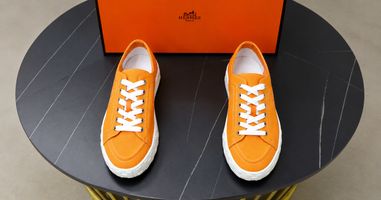
Hermès Men Shoes Fit Slip,Instep Pressure,and Toe Room Explained
Hermès men shoes should not be judged by empty toe length alone.Heel slip matters when it changes your stride,instep pressure becomes a concern when compression is needed to keep the shoe secure,and toe room should be judged around the widest part of the forefoot.The first step is identifying whether the issue comes from size,adjustment,or shoe shape.
A fit issue should be located before it is corrected.Moving half a size up or down can improve one area while making another worse.
1.Three Fit Problems Can Look Like One Size Problem
Heel slip,instep pressure,and forefoot compression can all produce the same reaction:
The size must be wrong.
That is sometimes true,but not always.
A shoe can feel loose at the heel while already pressing against the forefoot.Another can have enough toe length but place the widest part of the foot too far forward.A loafer may stay on only because the vamp presses heavily against the instep.
Before changing size,ask:
•Where does the foot move?
•Where does pressure appear?
•Does adjustment improve the issue?
•Does fixing one area create another?
Locate the fit problem before trying to correct it.
2.Heel Slip Is Not Automatically a Reason to Size Down
A small amount of heel movement does not automatically mean the shoe is too large.
Pay attention when:
•The heel rises noticeably with every step
•The foot slides forward as the heel lifts
•The toes begin gripping to keep the shoe on
•Turning makes the rear unstable
•Reasonable adjustment does not help
Sizing down may reduce heel lift,but it can also compress the forefoot or shift where the shoe bends.
If the front already feels secure or slightly tight,a smaller size may simply exchange one issue for another.
Heel movement should therefore be judged together with forefoot space and overall foot position.
3.Use the Lace Response to Diagnose Sneakers
Sneakers provide an adjustment tool that loafers and many sandals do not laces.
When checking hermès men sneakers,tighten them to a normal secure level and walk again.
If the heel becomes more stable without creating pressure elsewhere,the issue may have been adjustment rather than size.
If the heel only stays secure when the laces are pulled unusually tight,the internal volume may not match the foot well.
If tighter lacing improves the rear but creates strong instep pressure,the issue has simply moved.
Also watch for sideways shifting during turns or forward sliding on stairs.
The goal is steady control without forcing one small area of the upper to secure the entire foot.
4.Instep Pressure Matters More in Loafers
Loafers rely heavily on the relationship between vamp and instep because there are no laces to fine-tune the hold.
Too little contact can allow:
•Heel lift
•Forward sliding
•Toe gripping
•Instability during faster walking
Too much contact can create:
•Pressure across the instep
•A trapped feeling beneath the vamp
•Forefoot discomfort
The difficult case is a loafer that feels tight across the instep but loose at the heel.
Sizing up may relieve the top of the foot while increasing heel movement.Sizing down may improve rear security while making the vamp tighter.
That pattern can point to a mismatch in shoe shape rather than a straightforward size error.
5.Toe Room Should Be Judged at the Forefoot,Not the Tip
Empty space in front of the toes does not tell the full story.
The more important question is where the widest part of the foot sits relative to the widest usable area of the shoe.
Check:
•Whether the ball of the foot sits too far forward
•Whether the little toe is pushed inward
•Whether the big-toe joint presses against the side
•Whether the toes remain reasonably flat
•Whether the foot slides forward during movement
A shoe can have visible room at the front and still be too tight around the forefoot.
Empty toe space is not the same as usable forefoot space.
6.A Shoe Can Be Too Long and Too Tight at the Same Time
This sounds contradictory,but it is a useful pattern to recognize.
Imagine a shoe with:
•Space ahead of the toes
•Heel movement
•Pressure across the forefoot
The shoe may already be too long,yet still feel tight where the foot needs width.
Sizing down can reduce heel movement while increasing compression.Sizing up may add length without correcting where the shoe narrows.
When length and width problems move in opposite directions,the issue may be the shoe shape rather than the size number.
7.Sandals Need Edge Placement Rather Than Closed-Shoe Toe Rules
Open sandals require a different diagnosis.
Instead of focusing on empty space ahead of the toes,look at where the whole foot sits on the sole.
Check:
•Whether the toes stay inside the front edge
•Whether the heel stays within the rear boundary
•Whether the widest part of the foot spills beyond the sides
•Whether the upper secures the foot without excessive pressure
•Whether the foot shifts forward while walking
For hermès men's sandals,a size can look plausible from the upper while still placing the foot poorly on the platform.
The sandal should not merely fit beneath the straps.The foot should sit where the sole was designed to support it.
8.Walking Reveals Problems That Standing Can Hide
Standing shows where the foot begins.Movement shows whether it stays there.
Use a short sequence:
Walk straight.
Notice heel lift and forward sliding.
Turn.
Check whether the foot shifts sideways or the shoe twists around it.
Use stairs if possible.
Watch whether the toes move forward on descent or the heel becomes less secure.
A shoe that feels correct while standing can become unstable once the stride begins.
Movement is especially revealing when the fit feels almost right.
9.Do Not Let One Pressure Point Decide the Size
One uncomfortable area can dominate attention,but changing size in the direction that immediately relieves it is not automatically correct.
If the instep feels tight and you size up,check:
•Did heel movement increase?
•Did the foot begin sliding forward?
•Did the flex point shift?
•Does the shoe now rely on toe gripping?
The same logic applies in reverse.Sizing down to reduce heel slip is not useful if the forefoot becomes compressed.
Judge three areas together:
heel + forefoot + instep
If improving one consistently makes the others worse,the issue may lie in the shoe shape rather than the size.
10.When the Construction Is the Real Problem
Some fit patterns keep returning across nearby sizes.
A sneaker may remain loose at the heel unless the laces are pulled excessively tight.
A loafer may press across the instep in one size but slip badly at the heel in the next.
A derby may have enough length while the ball of the foot sits away from the main flex area.
A sandal may hold the upper securely while the foot still sits too close to one edge.
At that stage,it makes sense to compare other Hermès men shoes with different internal volumes,closures,upper shapes,and sole forms rather than forcing the same construction through repeated size changes.
Sometimes the shoe itself is the variable that needs to change.
11.Online Product Information Is a Starting Point,Not the Final Fit
Online product information can help identify what needs to be checked later.
Useful information includes:
•Closure type
•Adjustability
•Toe shape
•Upper material
•Sole form
•Instep coverage
•Any model-specific sizing guidance
Those facts can suggest where a fit issue may appear.
They cannot establish:
•Your exact heel volume
•Your instep height
•How your forefoot matches the internal width
•Whether pressure increases after walking
•Which size works for every foot
Published guidance gives you a starting direction.Actual fit signals determine whether that direction works.
12.The Better Size Should Solve the Whole Foot
Do not judge the final size by asking only where the shoe feels wrong.
Ask what happens everywhere else when that area is corrected.
If sizing down improves heel security but compresses the forefoot,the smaller size has not solved the fit.
If sizing up relieves instep pressure but creates repeated heel lift,the larger size has not solved it either.
If tighter lacing secures the heel only by creating excessive pressure across the top of the foot,adjustment has not solved the mismatch.
The right size should improve heel security,forefoot space,and overall foot position together.
For hermès men shoes,that whole-foot result matters more than forcing the foot into the most familiar number.
If solving one area consistently creates another issue,the shoe shape may be the problem rather than the size itself.
James Anderson
James Anderson is a luxury footwear writer specializing in designer shoes,fashion craftsmanship,and timeless style.He explores the materials,construction,heritage,and design philosophy behind iconic footwear brands,providing practical insights into choosing and styling luxury shoes for different occasions.His guides help readers understand the details behind premium footwear and how these pieces fit into modern wardrobes.